Clinician-trained Data & Analytics Delivery Lead with 10+ years in data & analytics and 5+ years in delivery leadership across public-sector, healthcare, and enterprise engagements. Co-author at CVPR 2026 on cross-dataset evaluation methodology for facial action units. Currently building agentic AI workflows for analytics automation.
Strong technical foundation in SQL data modeling, ETL/data warehousing, BI reporting (Tableau, Power BI, SSRS), and data quality/compliance. Skilled at performing Gap analysis, Risk analysis, and Cost/Benefit analysis, with end-to-end ownership of requirements, planning, delivery coordination, and stakeholder communication.
Open to new opportunities — let's connect.
MS in Business Analytics and Information Systems, 2021
University of South Florida
MBA in Health Sector Project Management, 2014
Cardiff Metropolitan University
BS, MS in Orthopedics, 2005 – 2012
Rajiv Gandhi University of Health Sciences
An agent-based pipeline for ingesting, enriching, and querying social-discourse sentiment data on a target brand or domain. Built from scratch to explore agentic AI architectures applied to enterprise-grade analytics workflows.
The system orchestrates LLM tool-use and retrieval-augmented generation over a vector store of enriched social media content, returning grounded sentiment summaries with citations to the source posts.
Live demo at agent.gurmeetk.com →
Subject-exclusive cross-validation is the standard evaluation protocol for facial Action Unit (AU) detection, yet reported improvements are often small. We show that cross-validation itself introduces measurable stochastic variance. On BP4D+, repeated 3-fold subject-exclusive splits produce an empirical noise floor of ± 0.065 in average F1, with substantially larger variation for low-prevalence AUs. Operating-point metrics such as F1 fluctuate more than threshold-independent measures such as AUC, and model ranking can change under different fold assignments. We further evaluate cross-dataset robustness using a Leave-One-Dataset-Out (LODO) protocol across five AU datasets. LODO removes partition randomness and exposes domain-level instability that is not visible under single-dataset cross-validation. Together, these results suggest that gains often reported in cross-fold validation may fall within protocol variance. Leave-one-dataset-out cross-validation yields more stable and interpretable findings.
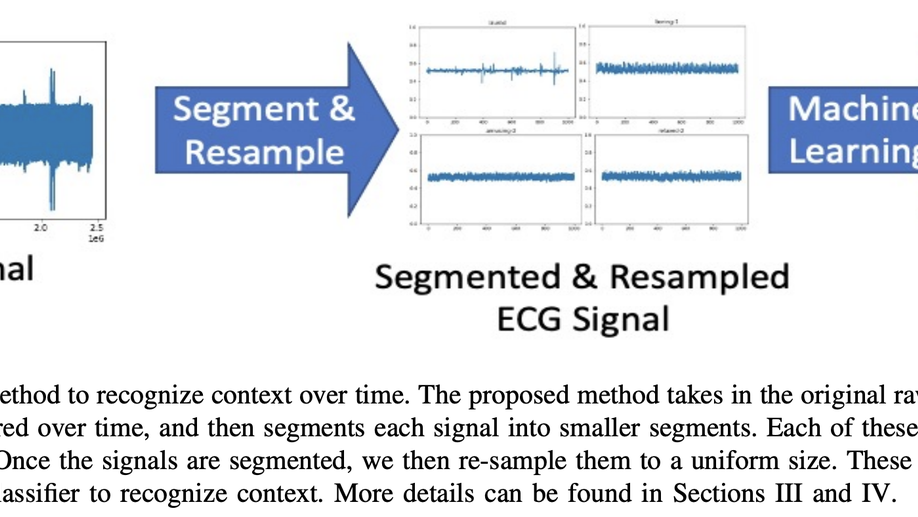
In this paper, we investigate recognizing context over time using physiological signals. Using the CASE dataset we evaluate both unimodal and multimodal approaches to physiological-based context recognition, over time. For recognition, we evaluate a random forest, as well as state-of-the-art neural network. These classifiers are evaluated using accuracy, Kappa, and F1-Macro metrics. Our results suggest that the fusion of EMG signals is more accurate, at recognizing context over time, compared to the fusion of non-EMG physiological signals. Although the fusion of non-EMG has a comparatively higher accuracy, ECG data results in the highest unimodal accuracy. Considering this, we analyze how the signals are correlated, including when the are fused (i.e. multimodal). We also perform a cross-gender analysis (e.g. training on male data and testing on female data) suggesting some generalizability across gender.
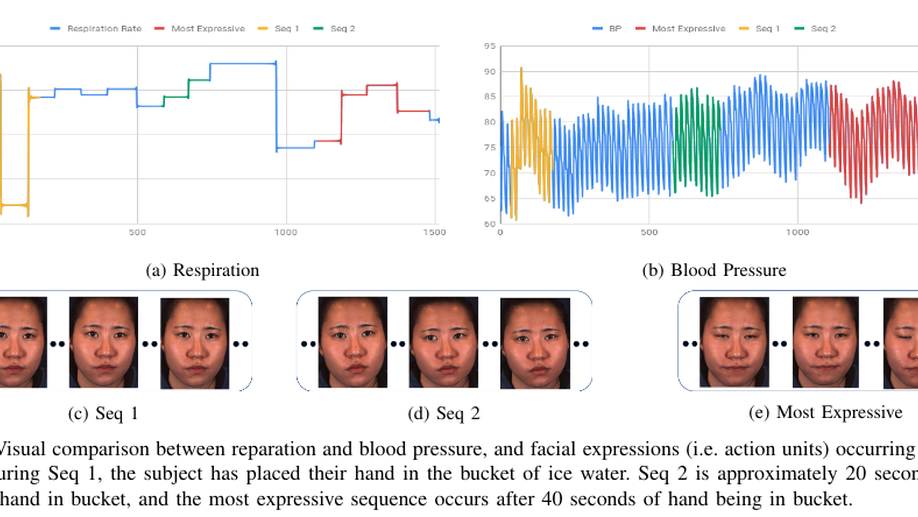
In this paper, we propose a method for pain recognition by fusing physiological signals (heart rate, respiration,blood pressure, and electrodermal activity) and facial actionunits. We provide experimental validation that the fusion ofthese signals results in a positive impact to the accuracy ofpain recognition, compared to using only one modality (i.e.physiological or action units). These experiments are conductedon subjects from the BP4D+ multimodal emotion corpus, andinclude same- and cross-gender experiments. We also investigatethe correlation between the two modalities to gain furtherinsight into applications of pain recognition. Results suggestthe need for larger and more varied datasets that includephysiological signals and action units that have been codedfor all facial frames.
Planned and Implemented project execution module by transforming corporate wellness with connected health and measurable engagement.
Responsibilities include:
Clients:
Planned and executed marketing programs based on market data analysis. Responsibilities include:
Managed End-to-End Credit business operations of the client hospitals by analysing patient data and ensuring medical record compliance standards.
Responsibilities include: